|
|
| Line 62: |
Line 62: |
| | The musical chimes changed automatically four times a day. The repertoire consisted of 16 different tunes, among them were Handel's symphony, the National Anthem(of that period), the Blue Bells of Scotland, Rule Britannia, Home Sweet Home and Auld Lang Syne. There were tuned to the key of C. | | The musical chimes changed automatically four times a day. The repertoire consisted of 16 different tunes, among them were Handel's symphony, the National Anthem(of that period), the Blue Bells of Scotland, Rule Britannia, Home Sweet Home and Auld Lang Syne. There were tuned to the key of C. |
| | | | |
| − | With the university clock in place, Mr. Lund "was prevailed upon" to set up shop in Bombay. Which he did at Sassoon Institute Building, Esplanade Road where a firm of the same name still operates. Turret clocks soon cropped up all over India- in the Kolhapur new palace,the Limbidi Durbar Hall, the Baroda Chimanbai Memorial Tower, the new G.I.P. Railway Terminus among others. But perhaps next to the Univeristy clock, the one that drew most attention was set up in their shop window itself. This was a "wonderful clock" that gave the time of all nations and was made by Mr. Lund himself. | + | With the university clock in place, Mr. Lund "was prevailed upon" to set up shop in Bombay. Which he did at Sassoon Institute Building, Esplanade Road where a firm of the same name still operates. Turret clocks soon cropped up all over India- in the Kolhapur new palace,the Limbidi Durbar Hall, the Baroda Chimanbai Memorial Tower, the new G.I.P. Railway Terminus among others. But perhaps next to the Univeristy clock, the one that drew most attention was set up in their shop window itself. This was a "wonderful clock" that gave the time of all nations and was made by Mr. Lund himself. |
| − | | |
| − | [[Image:Bombay university buildings 1870.jpg]]
| |
| − | | |
| − | An 1870 image of the Big Clock, the scaffoldings still in place
| |
| − | | |
| − | --------------------------
| |
| − | | |
| − | | |
| − | | |
| − | {{yearbox|
| |
| − | | in?=
| |
| − | | cp=18th century
| |
| − | | c=19th century
| |
| − | | cf=20th century
| |
| − | | |
| − | | yp1=1877
| |
| − | | yp2=1878
| |
| − | | yp3=1879
| |
| − | | year=1880
| |
| − | | ya1=1881
| |
| − | | ya2=1882
| |
| − | | ya3=1883
| |
| − | | |
| − | | dp3=1850s
| |
| − | | dp2=1860s
| |
| − | | dp1=1870s
| |
| − | | d=1880s
| |
| − | | dn1=1890s
| |
| − | | dn2=1900s
| |
| − | | dn3=1910s
| |
| − | }}
| |
| − | {{C19YearInTopic}}
| |
| − | | |
| − | '''1880''' ('''[[Roman numerals|MDCCCLXXX]]''') was a [[leap year starting on Thursday]] (see link for calendar).
| |
| − | | |
| − | ==Events==
| |
| − | | |
| − | ===January - April===
| |
| − | *[[February 2]] - The first electric [[streetlight]] is installed in [[Wabash, Indiana]].
| |
| − | | |
| − | ===May - August===
| |
| − | * [[May 13]] - In [[Menlo Park, New Jersey]], [[Thomas Edison]] performs the first test of his [[electric railway]].
| |
| − | * [[June 29]] - [[France]] annexes [[Tahiti]].
| |
| − | * [[July 1]] - First performance of ''[[O Canada]]'', the song that would become the [[national anthem]] of [[Canada]].
| |
| − | * [[July 16]] - First woman licensed to practice medicine in [[Canada]] - Dr. [[Emily Howard Stowe]].
| |
| − | | |
| − | ===September - December===
| |
| − | * [[September 5]] - First successful test of an electric [[Tram]] in the world takes place in [[St. Petersburg]], [[Russia]].
| |
| − | * [[October]] - terrible winter storm in [[North America]], the "[[Blizzard]] of 1880".
| |
| − | * [[October 15]] - [[Mexico|Mexican]] soldiers kill [[Victorio]], one of the greatest [[Apache Tribe|Apache]] military strategists.
| |
| − | * [[October 28]] - The first stone was laid for the [[Clarkson Memorial]] in [[Wisbech]].
| |
| − | * [[November]] - [[James Garfield]] defeats [[Winfield S. Hancock]] in the [[U.S. presidential election, 1880|U.S. presidential election]].
| |
| − | * [[November 4]] - the first cash register was patented by James and [[John Ritty]] of [[Dayton, Ohio]].
| |
| − | * [[November 11]] - [[Australia]]n bushranger and bank robber [[Ned Kelly]] is hanged in [[Melbourne]].
| |
| − | * [[November 22]] - [[Vaudeville]] actress [[Lillian Russell]] makes her debut at [[Tony Pastor]]'s Theatre in [[New York City]].
| |
| − | * [[December 20]] - [[Action at Bronkhorstspruit]], the first major action of the [[First Boer War]].
| |
| − | * [[December 30]] - The [[Transvaal]] becomes a republic and [[Paul Kruger]] becomes its first president.
| |
| − | | |
| − | ===Unknown date===
| |
| − | * Discovery of [[piezoelectricity]] by [[Pierre Curie]] and [[Jacques Curie]].
| |
| − | * Completion of [[Cologne cathedral]].
| |
| − | * Founding of ''[[Science (journal)|Science]]'' by [[Thomas Edison]].
| |
| − | * [[Cocaine]] isolated.
| |
| − | * The [[United Kingdom|British]] recognise [[Abdur Rahman Khan]] as amir of [[Afghanistan]].
| |
| − | * [[Capuchin catacombs of Palermo]] are officially closed (there will be some burials afterwards).
| |
| − | * [[Department of Scientific Temperance Instruction]] of the [[Women's Christian Temperance Union]] established.
| |
| − | | |
| − | ==Births==
| |
| − | * [[January 6]] - [[Tom Mix]], American actor (d. [[1940]])
| |
| − | * [[January 17]] - [[Mack Sennett]], Canadian director and producer (d. [[1960]])
| |
| − | * [[January 26]] - [[Douglas MacArthur]], American general (d. [[1964]])
| |
| − | * [[January 28]] - [[Herbert Strudwick]], English cricketer (d. [[1970]])
| |
| − | * [[January 29]] - [[W.C. Fields]], American actor (d. [[1946]])
| |
| − | * [[February 5]] - [[Gabriel Voisin]], French aviation pioneer (d. [[1973]])
| |
| − | * [[February 8]] - [[Franz Marc]], German artist (d. [[1916]])
| |
| − | * [[February 12]] - [[John L. Lewis]], American labor union leader (d. [[1969]])
| |
| − | * [[February 21]] - [[Waldemar Bonsels]], German writer (d. [[1952]])
| |
| − | * [[February 22]] - [[Frigyes Riesz]], Hungarian mathematician (d. [[1956]])
| |
| − | * [[March 1]] - [[Giles Lytton Strachey]], British writer and biographer (d. [[1932]])
| |
| − | * [[March 10]] - [[Bronco Billy Anderson]], American actor (d. [[1971]])
| |
| − | * [[March 11]] - [[Harry H. Laughlin]], [[United States|American]] [[Eugenics|eugenicist]] (d. [[1943]])
| |
| − | * [[March 22]] - [[Kuniaki Koiso]], [[Prime Minister of Japan]] (d. [[1950]])
| |
| − | * [[March 30]] - [[Sean O'Casey]], Irish writer (d. [[1964]])
| |
| − | * [[April 13]] - [[Charles Christie]], Canadian-born film studio owner (d. [[1955]])
| |
| − | * [[April 15]] - [[Max Wertheimer]], Father of Gestalt Theory (d. [[1943]])
| |
| − | * [[April 18]] - [[Sam Crawford]], [[Baseball Hall of Fame]]r (d. [[1968]])
| |
| − | * [[May 6]] - [[Ernst Ludwig Kirchner]], German painter (d. [[1938]])
| |
| − | * [[May 14]] - [[B.C. Forbes]], Scottish-born financial publisher (d. [[1954]])
| |
| − | * [[May 25]] - [[Jean Alexandre Barré]], French neurologist (d. [[1967]])
| |
| − | * [[May 25]] - [[Alf Common]], English footballer (d. [[1946]])
| |
| − | * [[May 29]] - [[Oswald Spengler]], German philosopher (d. [[1936]])
| |
| − | * [[June 6]] - [[W.T. Cosgrave]], Irish politician (d. [[1965]])
| |
| − | * [[June 27]] - [[Helen Keller]], American spokeswoman for the deaf and blind (d. [[1968]])
| |
| − | * [[July 5]] - [[Jan Kubelík]], Czech violinist (d. [[1940]])
| |
| − | * [[July 21]] - [[Milan Rastislav Štefánik]], Slovak General, politician, and astronomer (d. [[1919]]).
| |
| − | * [[July 24]] - [[Ernest Bloch]], Swiss-born composer (d. [[1959]])
| |
| − | * [[August 6]] - [[Hans Moser (actor)|Hans Moser]], Austrian actor (d. [[1964]])
| |
| − | * [[August 8]] - [[Earle Page]], eleventh [[Prime Minister of Australia]] (d. [[1961]])
| |
| − | * [[August 10]] - [[Robert L. Thornton]], American businessman, philanthropist, and mayor of Dallas, Texas (d. [[1964]])
| |
| − | * [[August 22]] - [[George Herriman]], American cartoonist (d. [[1944]])
| |
| − | * [[August 26]] - [[Guillaume Apollinaire]], French poet (d. [[1918]])
| |
| − | * [[August 31]] - Queen [[Wilhelmina of the Netherlands]] (d. [[1962]])
| |
| − | * [[September 14]] - [[Archie Hahn]], American athlete (d. [[1955]])
| |
| − | * [[September 22]] - [[Christabel Pankhurst]], English suffragette (d. [[1958]])
| |
| − | * [[September 23]] - [[John Boyd Orr]], Scottish physician and biologist, recipient of the [[Nobel Peace Prize]] (d. [[1971]])
| |
| − | * [[October 23]] - [[Una O'Connor]], Irish actress (d. [[1959]])
| |
| − | * [[November 5]] - [[Richard Oswald]], Austrian film director (d. [[1963]])
| |
| − | * [[November 6]] - [[Robert Musil]], Austrian novelist (d. [[1942]])
| |
| − | * [[November 10]] - [[Jacob Epstein]], American-born sculptor (d. [[1959]])
| |
| − | * [[December 11]] - [[Frank Tarrant]], Australian cricketer (d. [[1951]])
| |
| − | * [[December 24]] - [[Johnny Gruelle]], American cartoonist and children's book author (d. [[1939]])
| |
| − | * [[December 31]] - [[George Marshall]], [[United States Secretary of State]], recipient of the [[Nobel Peace Prize]] (d. [[1959]])
| |
| − | * [[Reginald Claypoole Vanderbilt]], American equestrian (d. [[1925]])
| |
| − | * [[Joseph Trumpeldor]], Russian Zionist (d. [[1920]])
| |
| − | *[[Garfield Wood|Gar Wood]], American motorboat racer (d. [[1971]])
| |
| − | | |
| − | ==Unknown Birth Dates==
| |
| − | * [[William J. Simmons]], Founder of the second [[Ku Klux Klan]] (d. [[1945]])
| |
| − | * [[D. Leigh Colvin]], American [[temperance movement]] leader and [[Prohibition Party]] candidate for presidency in 1936 (d. ?)
| |
| − | | |
| − | ==Deaths==
| |
| − | * [[January 8]] - [[Joshua A. Norton]], self-anointed Emperor Norton I of the United States of America (b. [[1811]])
| |
| − | * [[March 31]] - [[Henryk Wieniawski]], Polish composer (b. [[1835]])
| |
| − | * [[May 4]] - [[Edward Clark (governor)|Edward Clark]], Confederate Governor of Texas (b. [[1815]])
| |
| − | * [[May 8]] - [[Gustave Flaubert]], French novelist (b. [[1821]])
| |
| − | * [[July 7]] - [[Lydia Child]], American novelist and abolitionist (b. [[1802]])
| |
| − | * [[August 17]] - [[Ole Bull]], Norwegian violinist (b. [[1810]])
| |
| − | * [[October 4]] - [[Jacques Offenbach]], German-born composer (b. [[1819]])
| |
| − | * [[November 11]] - [[Ned Kelly]], Australian bush ranger (hanged)
| |
| − | * [[December 22]] - [[George Eliot]], English writer (b. [[1819]])
| |
| − | | |
| − | | |
| − | [[Category:1880]]
| |
| − | | |
| − | [[af:1880]]
| |
| − | [[ar:1880]]
| |
| − | [[ast:1880]]
| |
| − | [[az:1880]]
| |
| − | [[bg:1880]]
| |
| − | [[be:1880]]
| |
| − | [[bs:1880]]
| |
| − | [[ca:1880]]
| |
| − | [[cv:1880]]
| |
| − | [[cs:1880]]
| |
| − | [[cy:1880]]
| |
| − | [[da:1880]]
| |
| − | [[de:1880]]
| |
| − | [[et:1880]]
| |
| − | [[el:1880]]
| |
| − | [[es:1880]]
| |
| − | [[eo:1880]]
| |
| − | [[eu:1880]]
| |
| − | [[fr:1880]]
| |
| − | [[fy:1880]]
| |
| − | [[ga:1880]]
| |
| − | [[gl:1880]]
| |
| − | [[ko:1880년]]
| |
| − | [[hr:1880]]
| |
| − | [[io:1880]]
| |
| − | [[id:1880]]
| |
| − | [[ia:1880]]
| |
| − | [[is:1880]]
| |
| − | [[it:1880]]
| |
| − | [[he:1880]]
| |
| − | [[ka:1880]]
| |
| − | [[csb:1880]]
| |
| − | [[la:1880]]
| |
| − | [[lt:1880]]
| |
| − | [[lb:1880]]
| |
| − | [[hu:1880]]
| |
| − | [[mk:1880]]
| |
| − | [[ms:1880]]
| |
| − | [[nap:1880]]
| |
| − | [[nl:1880]]
| |
| − | [[nds:1880]]
| |
| − | [[no:1880]]
| |
| − | [[nn:1880]]
| |
| − | [[os:1880]]
| |
| − | [[pl:1880]]
| |
| − | [[pt:1880]]
| |
| − | [[ro:1880]]
| |
| − | [[ru:1880]]
| |
| − | [[sq:1880]]
| |
| − | [[scn:1880]]
| |
| − | [[simple:1880]]
| |
| − | [[sk:1880]]
| |
| − | [[sl:1880]]
| |
| − | [[sr:1880]]
| |
| − | [[fi:1880]]
| |
| − | [[sv:1880]]
| |
| − | [[tt:1880]]
| |
| − | [[th:พ.ศ. 2423]]
| |
| − | [[tr:1880]]
| |
| − | [[uk:1880]]
| |
| − | [[wa:1880]]
| |
| − | [[zh:1880年]]
| |
Lord Rippon- Viceroy of India
Annasaheb Kirloskar's sangeet "Shakuntal" introduces natya sangeet. Parsee Theatre to have its own immense curtains- a river, a hill behind, upon it a house and a road leading down with tamarind trees on either side.
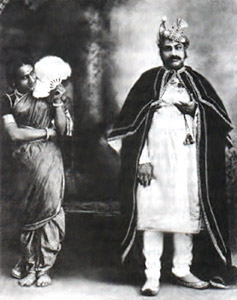
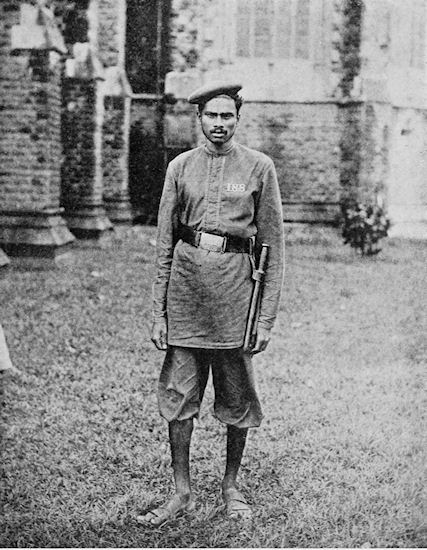
The imperial city of Bombay, the city that Dhundhi came to
The theatres in the city were magic boxes that lay between the streets, the offices and the houses where people lived their everyday lives. People sat facing large curtains which would part to transport them into spectacle and fantasy.
Spectacles were the very stuff of the city.. and all the new one- the theatre, the circus, were enclosed, roofed.
Sometimes a seated child would look away from the stage and stare at the high ceilings, and see for himself, how the box was a world unto itself, with its very own sky. Children loved the worlds in these boxes the most, they were magnificently different from the greyer world the adults had made outside, they were full of hyperbole and colour. Ramakrishna Paramhansa, not surprisingly, would love one such viewing of the theatre too.
Backdrops across painting and theatre
Backdrops opened new worlds that could change rapidly within the space of a show. Huge paintings- 14 or 18 feet high and 26- 28 feet wide, could make any world come alive.
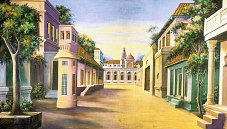
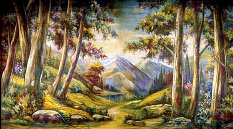
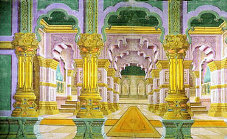
A lonely street where lovers meet under a smouldering afternoon sun
Factories belch smoke the colour of a deep evening sky, the back of a train in the distance, leaving its own trail of smoke, an Parsee gentleman races on his humpbacked tricycle, the wheels have painted clocks on them. Time and speed are money his painted image seems to say.
Unknown to him, his daughter steals out- there she is behind a pillar, no, she is under the shade of the lone tree in the city, meeting her down-on-luck lover.
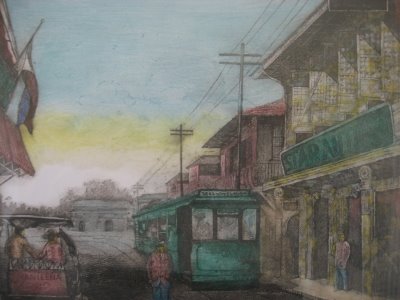
[1]
painted backdrops, 19th and early 20th century theatre in India
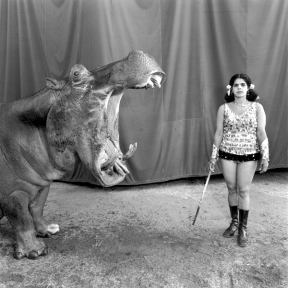
The first Big Top was brought to India in 1880 by an Englishman Willaim Chirney, who offered 500 gold coins to any Indian who could hassle a horse the way he did. The Raja of Kurdwad's stable hand, Vishnupant Chhatre, took up the challenge, and thus was born Chhatre's Circus, the precusor of other "Indian" circuses: Deval, Parashuram, Lion, Karlekar, Shellar, Rayman, Malabar and Whiteways..
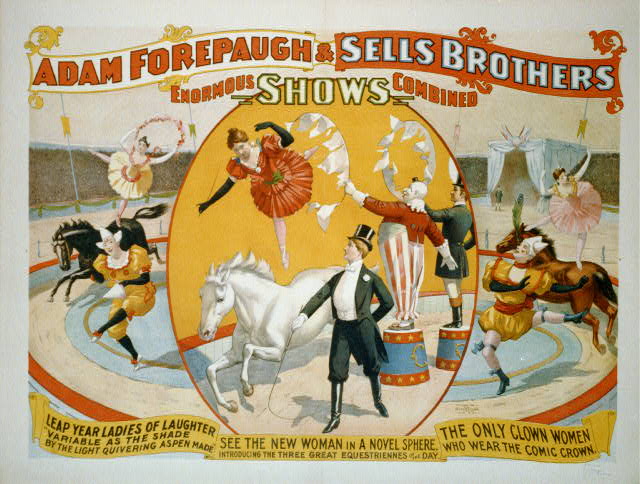
The roof of the circus tent was the sky of the world that you entered. Here anything could and must happen. An ill dressed magician had sold you a ticket at the gate. Limbs turned to jelly inside shimmering costumes, big animals danced and performed for the little ones, clowns were cursed with large boils on their noses
for always telling lies. Men fell down like bears and laughed, their paws in the air.
Bears wore frilly skirts and over them,bright blouses held together with strings.
Sometimes, the city itself became the theatre, and its sky, the roof of that theatre. To be a ruler also demanded its own public spectacles. Watchmakers delicately strained their eyes in lamplight to make a round and noisy sun that was levered up, slowly, with intricate scaffoldings, to take its place as the man made star over the city sky.
It sang the passing of the hours in popular British tunes of the day.

The Big Clock
When the University Library and Clock Tower were inaugrated by the Governor of Bombay, Sir Richard Temple, on February 27, 1880, neither the clock nor the joy bells were in place. They were installed two years later.
The contract for the tower clock had been given to Lund and Blockley, at British firm in London that dated back to 1725. In 1879, Mr. George Lund, a member of the Lund family that had been well-known for generations in London with the working of previous metals, jewellery and clocks, came to Bombay under contract from the government to erect the University clock.
Unique in design and of intricate worksmanship, it had been constructed in England from Mr. Lund's blueprints. In Bombay it was installed in the fifth storey of the Rajabai Tower, under the personal supervision of Mr. Lund himself. It consisted of the clock dials, twleve and a half feet in diameter, and the carillon machinery consisting of 16 bells and eighing 12 tons. The told cost of the clock and bells was Rs. 30,000.
The musical chimes changed automatically four times a day. The repertoire consisted of 16 different tunes, among them were Handel's symphony, the National Anthem(of that period), the Blue Bells of Scotland, Rule Britannia, Home Sweet Home and Auld Lang Syne. There were tuned to the key of C.
With the university clock in place, Mr. Lund "was prevailed upon" to set up shop in Bombay. Which he did at Sassoon Institute Building, Esplanade Road where a firm of the same name still operates. Turret clocks soon cropped up all over India- in the Kolhapur new palace,the Limbidi Durbar Hall, the Baroda Chimanbai Memorial Tower, the new G.I.P. Railway Terminus among others. But perhaps next to the Univeristy clock, the one that drew most attention was set up in their shop window itself. This was a "wonderful clock" that gave the time of all nations and was made by Mr. Lund himself.


![[1]](http://images.google.co.in/imgres?imgurl=http://www.hindu.com/fr/2008/01/18/images/2008011850140304.jpg&imgrefurl=http://www.hindu.com/fr/2008/01/18/stories/2008011850140300.htm&usg=__D8L_hBk-o-4pvgR2KFzPCYQWdwU=&h=129&w=227&sz=16&hl=en&start=1&tbnid=16aqwlGFA7cuVM:&tbnh=61&tbnw=108&prev=/images%3Fq%3Dindia%2B19th%2Bcentury%2Btheatre%2Bpainted%2Bbackdrops%26gbv%3D2%26hl%3Den%26sa%3DG)